

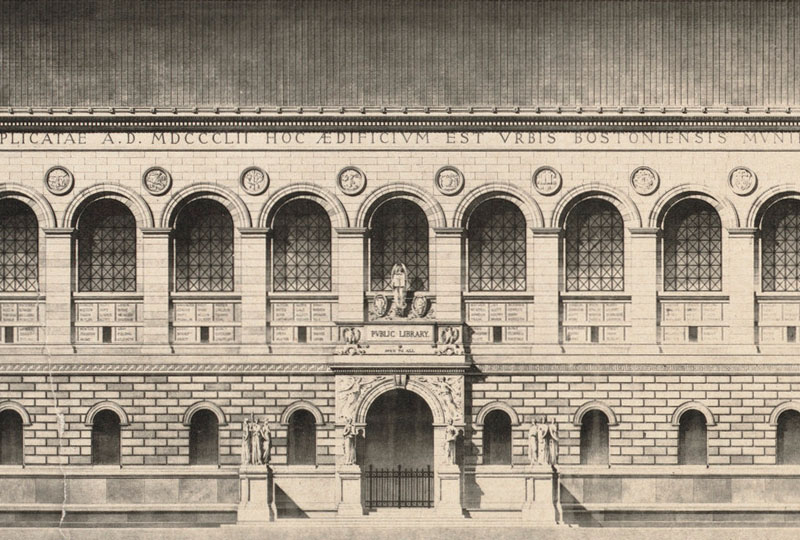
On September 11, 2026, the McQuillan Institute for Science, Technology and the Human Future launches its first major project, A Constitution for the 21st Century at the Boston Public Library. This “palace for the people” is a fitting place to begin querying how we, as citizens of the gene, of big data, and of a climate in transition, can reclaim voice and standing in how we are governed. Centering on the theme of democracy, this convening foregrounds the promises and challenges of citizenship in the midst of a technological revolution.
Program: September 11
Boston Public Library
6:30 PM — Reception and Dinner
Introduction
▶ Watch the recording (16 mins)
- John McQuillan, Co-Founder of the McQuillan Institute
- Sheila Jasanoff, Co-Founder of the McQuillan Institute
- Michelle Wu, Mayor of Boston
Keynote
▶ Watch the recording (20 mins)
- Jill Lepore, Harvard University
Musical Interlude
▶ Watch the recording (28 mins)
- Michael Cheng, AB Harvard 2019; JD Harvard 2024
Program: September 12
Norton’s Woods Conference Center, Cambridge MA
9:00 AM — Welcome and Introduction
▶ Watch the recording (8 mins)
- John McQuillan, Triumvirate Environmental & Co-Founder of the McQuillan Institute
- Sheila Jasanoff, Co-Founder of the McQuillan Institute
9:15 AM — Opening Keynote
▶ Watch the recording (29 mins)
- Leo E. Varadkar, Former Taoiseach of Ireland
9:45 AM — Panel 1: Thinking Constitutionally
▶ Watch the recording (1 hour 21 mins)
The 21st century began with two breakdowns in the basic presumptions of constitutional governance carried forward from the Enlightenment. First, populist movements gained power, impatient with institutions that seem unable to deliver promised levels of economic growth and social well-being, fueling autocracy and democratic backsliding. Second, digitally enabled statements and images, subject to no evidentiary guardrails, contributed to a rise in misinformation, conspiracy theories, and loss of trust in expertise. It is a truism to say that people who cannot know together cannot govern themselves, but what is to be done?
This panel reflects on our societies’ capacity to “think constitutionally” in this moment of rupture. Underlying the loss of trust in ruling institutions is the failure of modern politics and scholarship to grapple with the mismatch between political and epistemic delegation: the former theorized and endlessly debated in law and political science, the latter largely left untouched because of a faith in science and technological expertise as impersonal, apolitical forces that can inform political power without their own authority needing to be studied or questioned. What might it mean for citizens of a single planet, belonging to a single species, and increasingly governed by advances in science and technology to regain anything approaching voice and agency? How can today’s citizens of the gene, of big data, and of a climate in transition overcome vast disparities in wealth and social standing to meaningfully assert their aspirations to life, liberty, and the pursuit of happiness?
Moderator: Sheila Jasanoff, McQuillan Institute
- Craig Calhoun, Arizona State University
- Quinn Slobodian, Boston University
- Zephyr Teachout, Fordham Law School
- Yogendra Yadav, Indian author and activist
11:00 AM — Coffee break
11:30 AM — Panel 2: The Future of Progress
▶ Watch the recording (1 hour 18 mins)
Constitutional governance entails a faith that governments can steer the polity as a whole toward better futures. Such futures are thought to be constituted by scientific and technological advancements that increase prosperity, cure diseases and relieve us of physical burdens. This understanding of human progress is materialistic and instrumental, relying on experts’ ability to model the world and bring it under human powers to predict, manipulate, and control. It dominates the imaginative worlds of business, finance and industry by locating the search for human improvement in the next pill, energy technology, or AI breakthrough that will lead to new horizons of economic growth. Another very different imagination of human progress is constituted in terms of morality, ethics and politics. Progress, in this view, originates in political movements, ethical awareness, and advances in human self-understanding–for instance, by committing to the principle that all humans are created equal.
Panelists will examine how advances in science and technology relate to ideas of progress in politics and society. How have ideas of progress changed as new knowledge and new technological capabilities alter our sense of societal limits and possibilities? To what extent can the politics of today and tomorrow still be framed by inherited discourses of liberalism, modernity, and public reason? Were these ideas ever as universal or hegemonic as some theorists have taken them to be? With the advent of digital media, can alternative visions be identified, articulated, or highlighted in thinking about the purposes and practices of collective life? And in what ways can more humanistic understandings of progress arise in a time when reflection, deliberation, and moral understanding are arguably being displaced by the instruments of AI?
Moderator: Mathias Risse, Harvard Kennedy School
- Antón Barba-Kay, Georgetown University
- Archon Fung, Harvard Kennedy School
- Hélène Landemore, Yale University
- Sebastian Pfotenhauer, Technical University of Munich
12:45 PM — Lunch
McQuillan Institute information session
Screening and discussion of 1103 Sunsets by FUKUSHIMA MON AMOUR
- Miho Mazereeuw, MIT
2:15 PM — Panel 3: The Future of the Demos
▶ Watch the recording (1 hour 19 mins)
Democracy holds that power ultimately derives from the people who delegated their power to authorized rulers. Potent appeals to “the people” run through America’s civic heritage: the Preamble of the United States Constitution, Lincoln’s Gettysburg Address, protests against the Vietnam War, and the Civil Rights movement, to name a few. Yet, since the dawn of modernity, developments in science and technology have been reconstituting notions of “the demos” as a political force. Historically, subjects of political rule were identified according to the territories in which they or their ancestors originated. Yet new technologies like gene editing, AI, and mass data collection transcend national boundaries and transform deeply held ideas of who is alive, who belongs in a given collective, and what it means to be in control of one’s life and privacy. In light of disruptions caused by a century of technological development, some are pushing the frontiers of the demos to make room for non-human entities, arguing that technological and environmental changes demand closer ties between humans and non-humans. At the same time, ascendant political forces are reasserting territorial boundaries against increased migration, climate refugees, and political upheaval in other territories.
Panelists will discuss how the technologically mediated reconfiguration of the rights, entitlements, and identities of citizens is affecting our understanding of the demos. What constitutes a valid claim to speak on behalf of “the people” and how do we assess the legitimacy of such claims? Should the frontier of rights belonging solely to humans be expanded to include non-humans and thinking machines? And what means of political expression are available to a global public vulnerable to cross-border developments in science and technology?
Moderator: Aziza Ahmed, Boston University School of Law
- Karen Engle, University of Texas Law School
- Sarah Igo, Vanderbilt University
- Lawrence Liang, BML Munjal University
- Douglas Kysar, Yale Law School
3:30 PM — Coffee break
3:45 PM — Panel 4: The Future of Expertise
▶ Watch the recording (1 hour 18 mins)
In modern democracies, the relationship between those who govern and those who are governed is often mediated by experts, whose knowledge and skills underwrite most state interventions. The so-called “post-truth” era speaks to a moment in which this three-way relationship is under increasing strain. Skepticism toward traditionally respected centers of knowledge production, such as research universities, national labs, and expert agencies, is openly expressed at the highest levels of power, especially in the United States. At the same time, in an era of open information, the inadequacy of the classic “deficit model” of a public that simply misunderstands science or denies “objective” truths has also become apparent. There is a growing recognition that both rulers and scholars must pay more attention to foundational changes in how the public asserts its own right to see and evaluate the world around it.
This panel will reflect on how sweeping social changes—in material wellbeing, religious identification, and political emancipation, among others—are shaping both the uptake of expert knowledge and civic expectations of what forms of government are reasonable, legitimate or desirable. How have democracies navigated competing claims of “objective truth”? What role should allegedly impersonal tools of the digital age, such as “big data” or algorithms, play in public decision-making? What blind spots have emerged from policymakers’ growing reliance on economic, social, or scientific expertise? More generally, can a modern world order built on shared expert understandings of rightness and reason accommodate the forces of populism and calls for epistemic justice that are emerging in global politics?
Moderator: J. Benjamin Hurlbut, Arizona State University
- Joyce Chaplin, Harvard University
- David Kennedy, Harvard Law School
- Allison Stanger, Middlebury College
- Patricia J. Williams, Northeastern University
5:00 PM — Closing Remarks
▶ Watch the recording (27 mins)
- Kaushik Sunder Rajan, University of Chicago
- Brice Laurent, Mines Paris – PSL
- Sheila Jasanoff, McQuillan Institute