

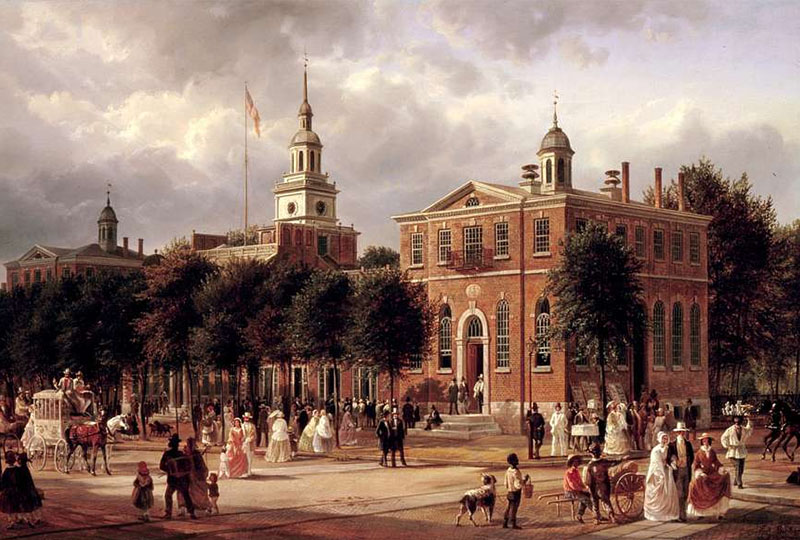
On October 29, 2026, as the United States marks 250 years since its founding, the McQuillan Institute travels to the cradle of the American Revolution in Philadelphia to ask: How are the few empowered to know for the many? And how do we hold them to account? Our co-host here is the American Philosophical Society, founded by Benjamin Franklin in 1743 for the purpose of “promoting useful knowledge.”
Program
3:00 PM — Panel 1: American Citizenship and Public Reason since 1776
At the 250th anniversary of the United States, democratic governance confronts a central but neglected paradox. From its founding, the US government has struggled to define the proper relationship between “the people” and their elected representatives, through both federal and state constitutions. Political theory and practice are preoccupied with the legitimacy of those elected to make decisions in our name. We have, however, left largely implicit the constitutional role of the experts and institutions tasked with knowing for the people. From Jefferson’s faith in citizens’ enlightened rationality to the recent Supreme Court ruling against so-called “expert agencies” in the Loper Bright case, American politics is loaded with claims and counterclaims that experts, by virtue of specialized knowledge, have a legitimate right to govern in our name. This panel interrogates how ideas of what citizens should know and how they should be governed have been linked from the founding to the present. How are the few empowered to know for the many? What visions of citizen understanding and capacity are embedded in institutions and processes of public reasoning? And how, over time, has the American public held experts to account? The panel brings together historians, social theorists, and Science and Technology Studies (STS) scholars to address the thorny questions of expertise, trust, and democracy that lie at the heart of American politics.
Panelists:
- Professor Bentley Allan, Johns Hopkins University
- Professor D. Graham Burnett, Princeton University
- Professor J. Benjamin Hurlbut, Arizona State University
- Professor Sophia Rosenfeld, University of Pennsylvania
4:15 PM — Panel 2: The Ethics of Invention at the Frontiers of Life
The rights to “life, liberty, and the pursuit of happiness” enjoy a central position in our civic lexicon. More often than not, the interpretation of these words turns upon the meaning accorded to the word liberty. Recent developments in the biosciences and technologies, however, have destabilized our understanding of the meaning and worth of human life. Biotechnologies are increasingly developing the power to control the dynamics of life, from reproduction to aging and dying, raising difficult questions of what counts as life and when interventions spill over limits that society sees as inviolable. These developments often transcend the territorial boundaries of nation-states and concentrate power outside of democratic processes. This panel convenes a fascinating juxtaposition of creative arts, law, bioethics, and cutting edge science to reflect on the challenges to protecting the dignity of human life as knowledge and technology advance. What are the responsibilities of scientists, citizens, ethical experts, and the state in steering technologies with the potential to redefine what it means to be human? How can societies navigate between competing notions of progress and risk? And how can we imagine a politics that embraces the thirst for new knowledge while also expressing and respecting the dignity of human life?
Panelists:
- Yoi Kawakubo, artist and filmmaker
- Professor Adriana Petryna, University of Pennsylvania
- Professor Kiran Musunuru, University of Pennsylvania
- Professor O. Carter Snead, University of Notre Dame
6:00 PM — Keynote: A Constitution for the 21st Century
Keynote:
- Sheila Jasanoff, Co-Founder of the McQuillan Institute
Discussant:
- Linda Greenhouse, Yale Law School